排序

排序数组[321]

思路

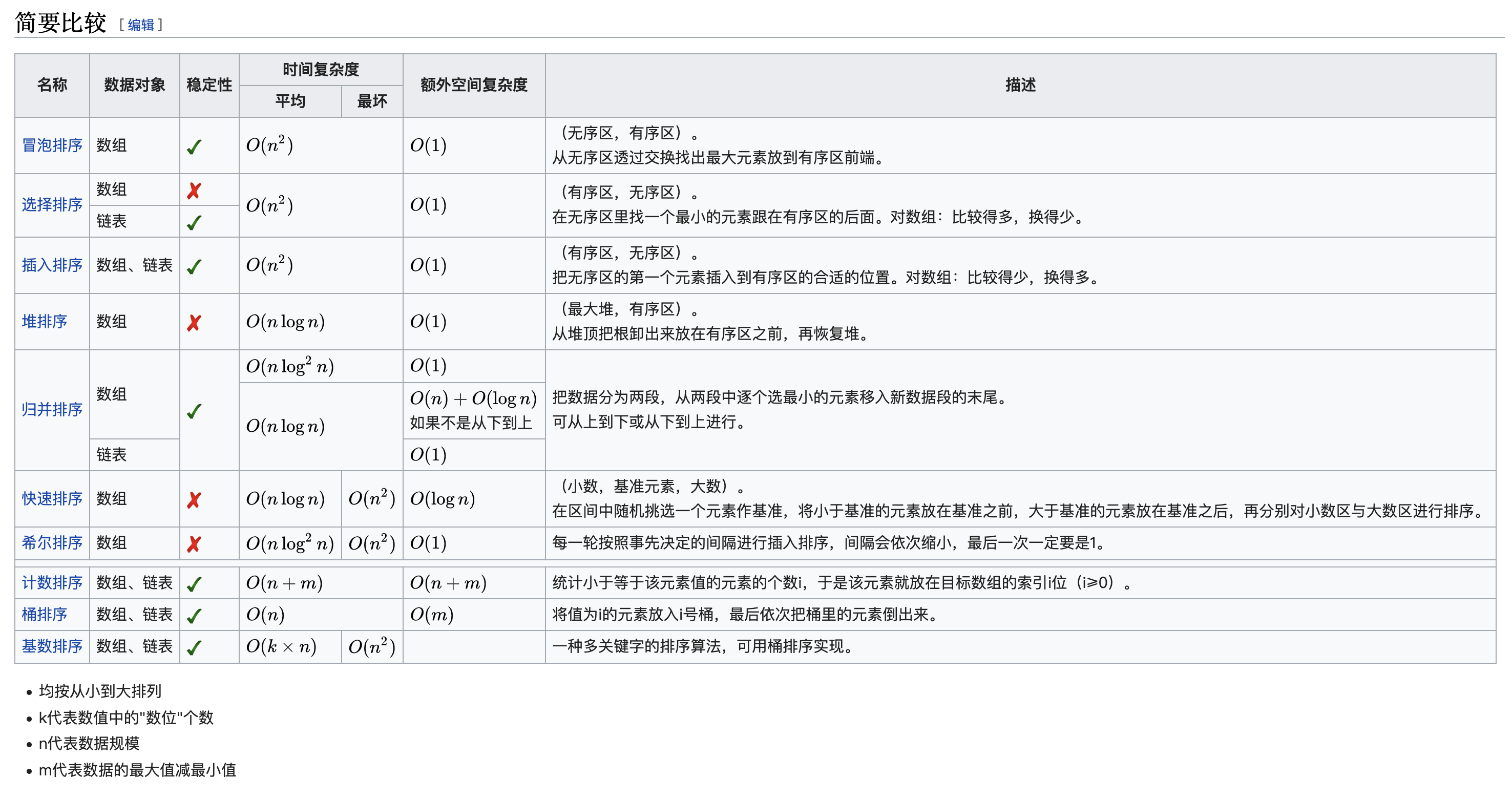
快排,堆,计数,归并

  1. 快排
1
2
3
4
5
6
7
8
9
10
11
12
13
14
15
16
17
18
19
20
21
22
23
24
25
26
27
28
29
30
31
32
33
34
35
36
37
38
39
40
41
42
43
44
class Solution {
public static Random random = new Random();
public int[] sortArray(int[] nums) {
sort(nums, 0, nums.length - 1);
return nums;
}
public void sort(int []nums, int l, int r){
if( l >= r) return;

int indexX = partition(nums, l, r);
//l....indexX
sort(nums, l ,indexX - 1);
//indeX...r
sort(nums, indexX + 1, r);
}
public int partition(int []nums, int l, int r){
int i = l + random.nextInt( r - l + 1);
int x = nums[i];
swap(nums, l, i);
int curL = l + 1;
int curR = r;
while(true){
while(curL <= curR && nums[curL] < x){
curL++;
}
while(curL <= curR && nums[curR] > x){
curR--;
}
if(curL >= curR) break;

swap(nums, curL, curR);
curL++;
curR--;
}
swap(nums, l, curR);

return curR;
}
public void swap(int []nums, int i, int j){
int temp = nums[i];
nums[i] = nums[j];
nums[j] = temp;
}
}
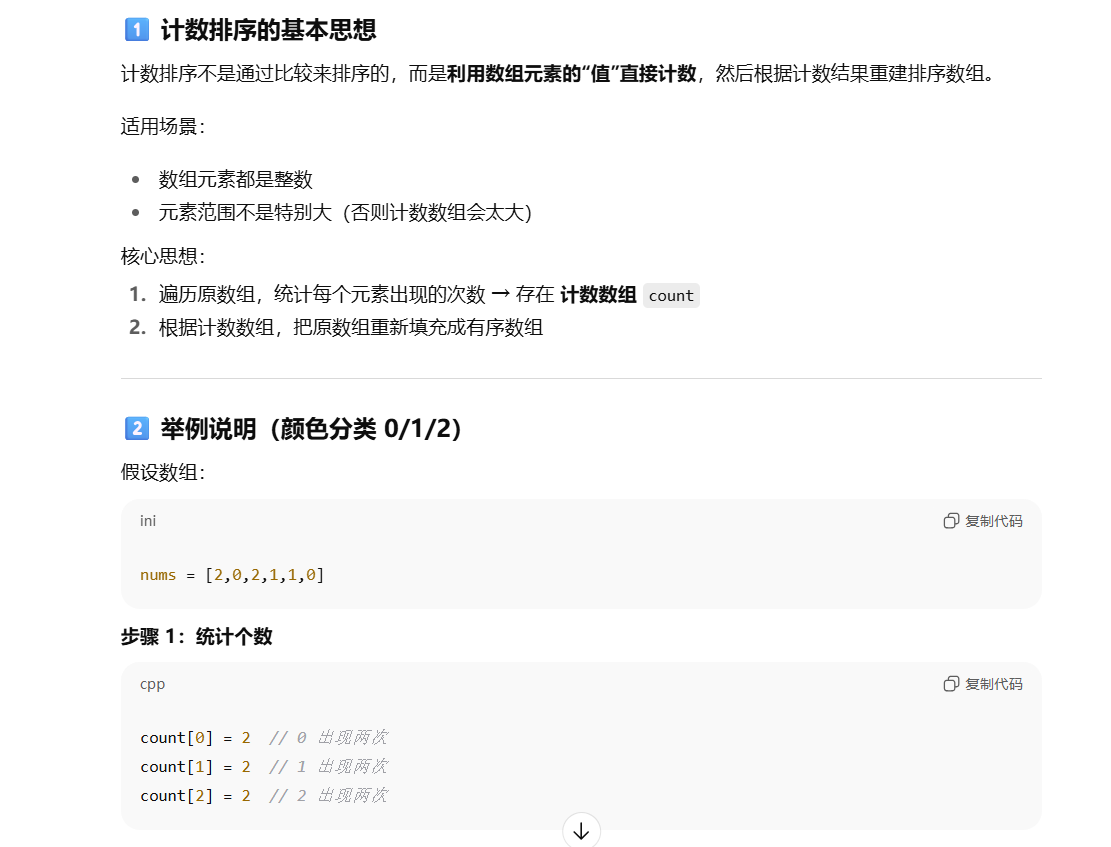
  1. 题目特殊性,时间复杂度为O(N)的解法,采用计数排序

https://leetcode.cn/problems/sort-an-array/solutions/179210/dang-wo-tan-pai-xu-shi-wo-zai-tan-xie-shi-yao-by-s/

1
2
3
4
5
6
7
8
9
10
11
12
13
14
15
16
17
18
19
20
21
22
23
24
25

class Solution {
public int[] sortArray(int[] nums) {
int max = 50001;
int min = -50001;

int[] counter = new int[max - min + 1];
for (int num : nums) {
counter[num - min]++;
}
int index = 0;
//index 为 数组值 value为 数组值的个数
for (int i = min; i <= max; i++) {
int cnt = counter[i - min];
// cnt > 0说明存在
while (cnt > 0) {
nums[index] = i;
cnt--;
index++;
}
}
return nums;
}
}

  1. 归并排序
1
2
3
4
5
6
7
8
9
10
11
12
13
14
15
16
17
18
19
20
21
22
23
24
25
26
27
28
29
30
31
32
33
34
35
36
37
38
39
40
41
42
43
44
45
46
47
48
49
50
51
52
53
54
55
56
class Solution {
public int[] sortArray(int[] nums) {
sort(nums, 0, nums.length - 1);
return nums;
}
//归并排序
public void sort(int []nums, int l, int r){
if(l >= r) return;
int mid = l + (r - l) / 2;
sort(nums, l, mid);
sort(nums, mid + 1, r);
//合并 [l...mid] [mid + 1....r]
merge(nums, l, mid, mid + 1, r);
}
public void merge(int []nums, int s1, int e1, int s2, int e2){
// [s1...e1] [s1 ... e2]
int i = s1;
int j = s2;
// [2,4] [1,5]
// [1,2,4,]
int []temp = new int[e2 - s1 + 1];
int n = temp.length;
int k = 0;
while(i <= e1 || j <= e2){
while( i > e1 && j <= e2){
temp[k] = nums[j];
k++;
j++;
}
while(j > e2 && i <= e1){
temp[k] = nums[i];
k++;
i++;
}
if(k >= n) break;
//谁小谁先移动
if(nums[i] > nums[j]){
temp[k] = nums[j];
k++;
j++;
}
else {
temp[k] = nums[i];
k++;
i++;
}
}
System.arraycopy(temp, 0, nums, s1, temp.length);

}
public void swap(int[] nums, int i, int j){
int temp = nums[i];
nums[i] = nums[j];
nums[j] = temp;
}
}

字典序排数[13]

思路:

1
2
3
4
5
6
7
8
9
10
11
12
13
14
15
16
17
18
19
20
21
class Solution {
public List<Integer> lexicalOrder(int n) {
//256
// 1 10 100 101...109 11
List<Integer> res = new ArrayList();
for (int i = 0, j = 1; i < n; i++) {
res.add(j);
if (j * 10 <= n) {
j = j * 10;
} else {
// 1 10 100 101...109 11 or 1,2
// 109 -> 11 ,2 -> 3
while (j % 10 == 9 || j + 1 > n) {
j = j / 10;
}
j++;
}
}
return res;
}
}

排序链表[133]

思路:

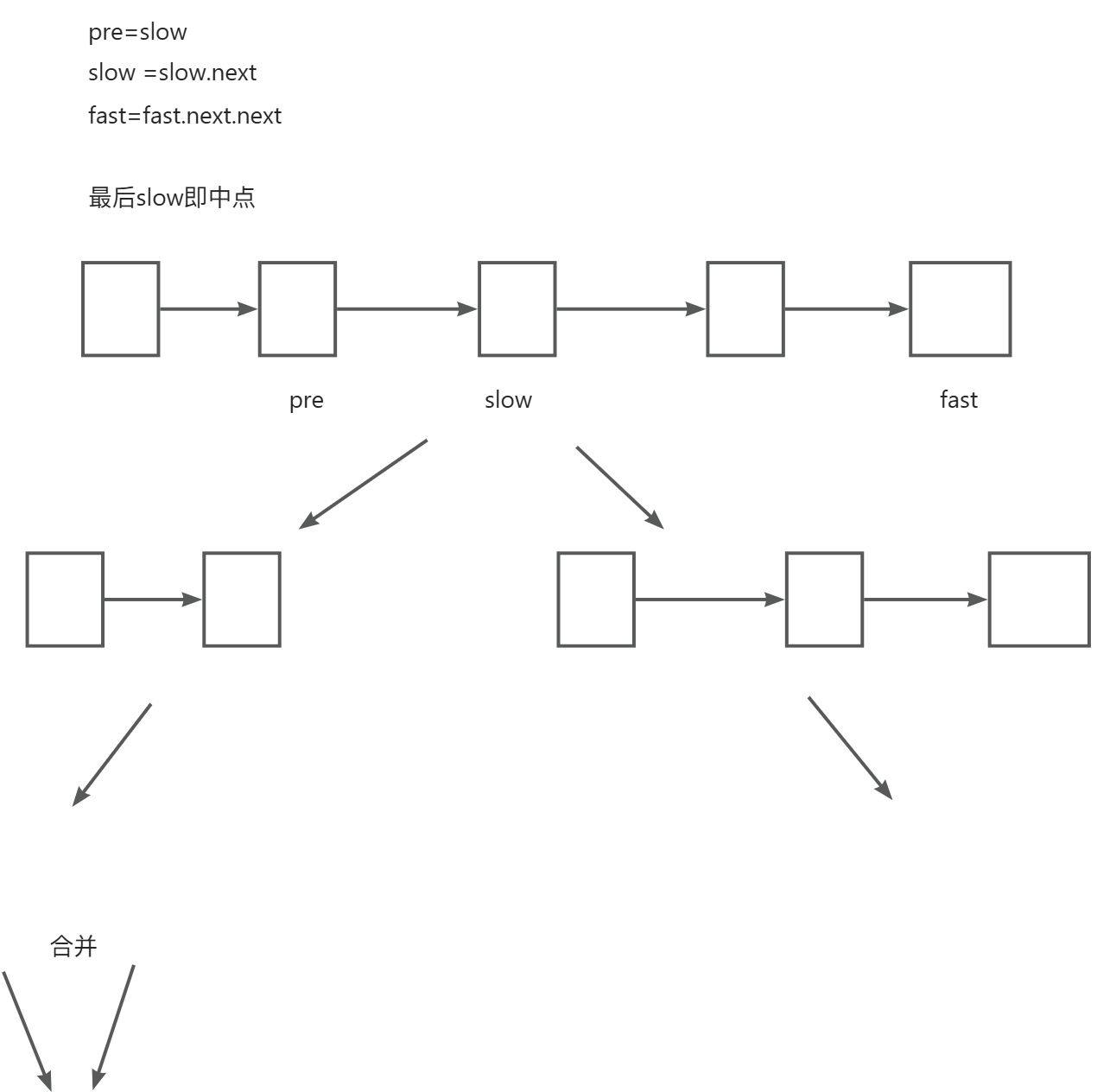
  1. 归并排序
    head….tail-> head….mid mid…tail

不断分,然后并起来

归:对链表进行分割,直到每个链表只有一个 元素

并:对链表进行升序合并

链表取中点(快慢指针),并切割

  1. 快排(容易超时)

图(归并)

画板

1
2
3
4
5
6
7
8
9
10
11
12
13
14
15
16
17
18
19
20
21
22
23
24
25
26
27
28
29
30
31
32
33
34
35
36
37
38
39
40
41
42
43
44
45
46
47
48
49
50
51
52
53
54
55
56
57
58
59
60
61
62
63
64
65
66
67
68
69
70
71
72
73
/**
* Definition for singly-linked list.
* public class ListNode {
* int val;
* ListNode next;
* ListNode() {}
* ListNode(int val) { this.val = val; }
* ListNode(int val, ListNode next) { this.val = val; this.next = next; }
* }
*/
class Solution {
public ListNode sortList(ListNode head) {
return sort(head);
}

//从中间分开
public ListNode divide(ListNode head) {
ListNode fast = head;
ListNode slow = head;
ListNode pre = head;
while (fast != null && fast.next != null) {
pre = slow;
fast = fast.next.next;
slow = slow.next;
}
pre.next = null;
return slow;
}

//归并排序
public ListNode sort(ListNode head1) {
if (head1 == null || head1.next == null) {
return head1;
}
//拆成两部分,并返回后部门的头结点
ListNode head2 = divide(head1);
//mid(4→2→1→3) ---> 分成两部分
//head1: 4 → 2 → null
//head2: 1 → 3 → null
head1 = sort(head1);

head2 = sort(head2);

return merge(head1, head2);
}

//两链表合并,要有序
// head1 ....
// head2 ....
public ListNode merge(ListNode head1, ListNode head2) {
ListNode res = new ListNode();
ListNode cur = res;
while (head1 != null || head2 != null) {
if (head2 == null) {
cur.next = head1;
break;
}
if (head1 == null) {
cur.next = head2;
break;
}
if (head1.val > head2.val) {
cur.next = head2;
head2 = head2.next;
} else {
cur.next = head1;
head1 = head1.next;
}
cur = cur.next;
}
return res.next;
}
}

时间复杂度:NlogN 空间复杂度:logN

合并K个排序链表[221]

思路:

  1. 归并排序
  2. 堆(可能需要手写)排序
1
2
3
4
5
6
7
8
9
10
11
12
13
14
15
16
17
18
19
20
21
22
23
24
25
26
27
28
29
30
31
32
33
34
/**
* Definition for singly-linked list.
* public class ListNode {
* int val;
* ListNode next;
* ListNode() {}
* ListNode(int val) { this.val = val; }
* ListNode(int val, ListNode next) { this.val = val; this.next = next; }
* }
*/
class Solution {
public ListNode mergeKLists(ListNode[] lists) {
if(lists.length == 0) return null;
//最小堆,堆顶为最小值
PriorityQueue<ListNode> pq = new PriorityQueue<>((a, b) -> a.val - b.val);
//先将最小的放进来
for(ListNode head: lists){
if(head == null) continue;
pq.add(head);
}
ListNode dummyHead = new ListNode();
ListNode res = dummyHead;

while(!pq.isEmpty()){
ListNode minNode = pq.poll();
res.next = minNode;
res = res.next;
if(minNode.next != null){
pq.add(minNode.next);
}
}
return dummyHead.next;
}
}
  • 时间复杂度:O(Llogm),其中 m lists 的长度,L 为所有链表的长度之和。

数组中的第K个最大元素[550]

题目:

  1. 要求时间复杂度为O(N)

思路:

  1. 维护size == k的最小堆(但不符合题意)时间复杂度:nums.length log(k)
1
2
3
4
5
6
7
8
9
10
11
12
13
14
class Solution {
public int findKthLargest(int[] nums, int k) {
if(nums.length == 1) return nums[0];
PriorityQueue<Integer> pq = new PriorityQueue();
for(int i: nums){
pq.add(i);
if(pq.size() > k){
pq.poll();
}
}
//System.out.println(pq);
return pq.isEmpty()?-1:pq.poll();
}
}
  1. 快速选择

思路:

  1. 构建partition函数,里面干的就是 数组随机取一个 x,然后划分 x
  2. 如何划分!?
    1、小技巧,先将 l 和 x交换,方便后面处理

2、curL–> …. <—curR,while把curL和curR推进到需要交换的位置,然后swap,交换后,重复这个过程
外层while(true) 内层while 推进curL,curR。若curR<=curL退出全部循环

3、将x放回正确位置,—> swap(l,curR)

  1. 经过划分我们可以得到x。那么这个时候判断x的index 和 targetIndex( n - k)的位置
  2. 若 index = targertIdex 就是找到答案了,直接返回。若index > targetIndex 则说明targetIndex在右边,那么这个时候让r = index缩小范围,反之,让l = index
1
2
3
4
5
6
7
8
9
10
11
12
13
14
15
16
17
18
19
20
21
22
23
24
25
26
27
28
29
30
31
32
33
34
35
36
37
38
39
40
41
42
43
44
45
46
47
48
49
50
51
52
53
54
55
56
57
58
59
60
61
62
63
64
65
class Solution {
private static final Random rand = new Random();

public int findKthLargest(int[] nums, int k) {
//选一个基准 元素 x
// <x.... x... >x
//如果 i = n - k ,那么 res = i
//如果 i > n - k, 那么res在左侧,我们在其中寻找,重复第一步
//如果 i < n - k, 那么res在右侧,我们在其中寻找,重复第一步
if(nums.length < k) return -1;
int n = nums.length;
int l = 0;
int r = n - 1;
int targetIndex = n - k;
while(true){
int resIndex = partition(nums, l, r);
if(resIndex == targetIndex){
return nums[resIndex];
}
//redIndex 在 targetIndex右边 说明 targetIndex的数在 l...resIndex 中
else if(resIndex > targetIndex){
r = resIndex - 1;
}
else {
l = resIndex + 1;
}
}
}
public int partition(int []nums, int l, int r){
int i = l + rand.nextInt(r - l + 1);
int x = nums[i];
//System.out.println(x);
//交换左边界元素 和 x,方便后面实现
swap(nums, l, i);
//System.out.println(Arrays.toString(nums));
int curL = l + 1;
int curR = r;
//处理示意图: (< x) curL-> (没处理的元素) <-curR ( > x)
while(true){
while(curL <= curR && nums[curL] < x){
curL++;
}
//经过上面的while循环此时 nums[curL] >= x
while(curL <= curR && nums[curR] > x){
curR--;
}
//经过上面的while循环此时 nums[curL] <= x
if(curL >= curR) break;
swap(nums, curL, curR);
curR--;
curL++;
}

//System.out.println(Arrays.toString(nums));
swap(nums, l, curR);
//System.out.println(Arrays.toString(nums));
return curR;
}
// 交换 nums[i] 与 nums[j]
private void swap(int[] nums, int i, int j) {
int tmp = nums[i];
nums[i] = nums[j];
nums[j] = tmp;
}
}

颜色分类[41]

思路:

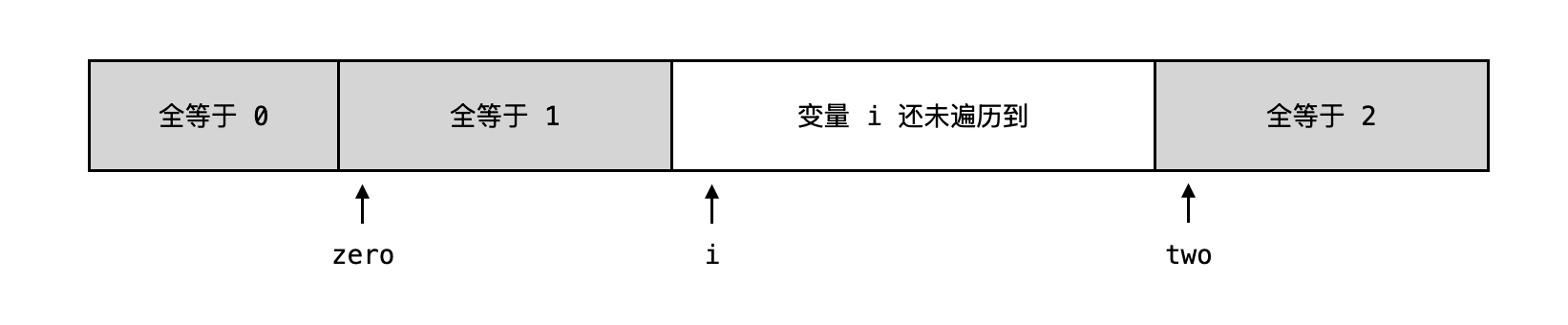
  1. 三路快排(三指针法)。0…zero i two…n -1
1
2
3
4
5
6
7
8
9
10
11
12
13
14
15
16
17
18
19
20
21
22
23
24
25
26
27
28
29
30
31
32
33
34
35


class Solution {
public void sortColors(int[] nums) {
int n = nums.length;


int i = 0;
int zero = 0;
int two = n - 1;
//[0 zero] 全为 0
//[zero i] 全为 1
//[two, n-1] 全为 2
// 0 1 2
while(i <= two){
if(nums[i] == 0){
swap(nums, i, zero);
zero++;
i++;
}
else if(nums[i] == 1){
i++;
}
else {
swap(nums, i, two);
two--;
}
}
}
public void swap(int[] nums, int i, int j){
int temp = nums[i];
nums[i] = nums[j];
nums[j] = temp;
}
}

或者计数排序

1
2
3
4
5
6
7
8
9
10
11
12
13
14
15
16
17
class Solution {
public void sortColors(int[] nums) {
int[] counter = new int[3];
for(int i: nums){
counter[i]++;
}
int index = 0;
for(int i = 0; i < 3; i++){
int cnt = counter[i];
while(cnt > 0) {
nums[index] = i;
index++;
cnt--;
}
}
}
}